
 Medical Modular Storage

 English
 Español
 Portugues
 Français
 Deutsch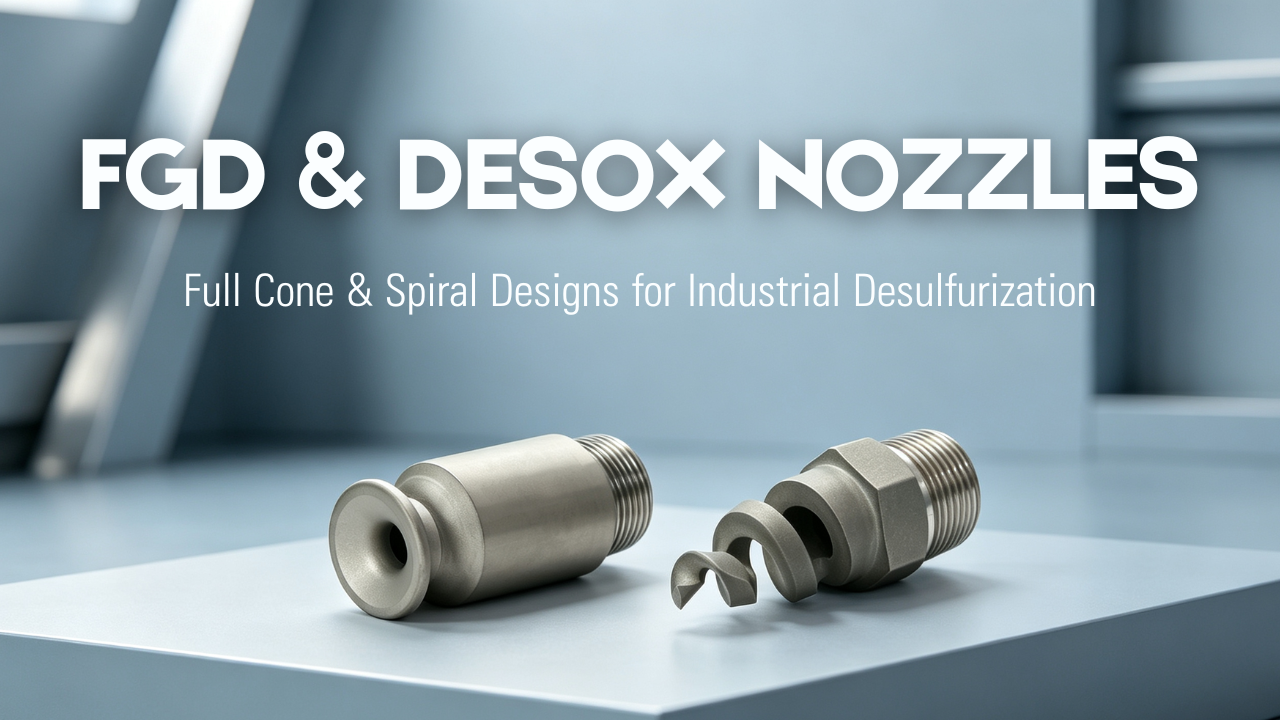
Industrial desulfurization nozzles are used in wet flue gas desulfurization (FGD) systems to distribute limestone slurry inside absorber towers. The spray creates the gas-liquid contact required to remove sulfur dioxide (SO₂) from flue gas.
FGD nozzles must handle abrasive solids, corrosive slurry, high flow rates, and continuous operation. Large full cone and spiral nozzles are commonly used, with silicon carbide (SiC) and stainless steel among the main material options.
This guide covers FGD nozzle types, materials, common wear problems, and the key parameters used for nozzle selection.
What Is an Industrial Desulfurization Nozzle?
An industrial desulfurization nozzle, also called an FGD nozzle, DeSOx nozzle, or flue gas desulfurization nozzle, is installed on spray headers inside a scrubber or absorber tower.
In a wet FGD system, limestone slurry is pumped through the spray headers and discharged downward through multiple nozzles. At the same time, flue gas flows upward through the absorber.
The nozzle creates a controlled spray pattern that provides sufficient gas-liquid contact for SO₂ absorption. The absorbed sulfur compounds react with calcium-based absorbents in the slurry.
FGD nozzles operate under conditions that are more severe than many conventional industrial spray applications:
- High suspended solids
- Abrasive limestone particles
- Corrosive slurry
- High flow rates
- Continuous operation
Nozzle wear, blockage, or changes in spray distribution can affect the performance of the spray layer.
How Do FGD Spray Nozzles Work?
The droplets travel downward through the upward-moving flue gas. This creates the gas-liquid contact needed for SO₂ absorption.
The simplified chemical reactions are:
SO₂ + H₂O → H₂SO₃
CaCO₃ + H₂SO₃ → CaSO₃ + CO₂ + H₂O
In forced-oxidation systems, calcium sulfite is further oxidized to gypsum.
The nozzle therefore needs to provide the required flow rate, spray angle, distribution, and droplet characteristics while maintaining stable performance as the nozzle wears.
Full Cone vs. Spiral Nozzles
Large full cone and spiral nozzles are two common designs for wet FGD spray systems. They use different internal flow paths and produce different spray distributions.
Large Full Cone Nozzles
A large full cone nozzle produces a spray cone filled with liquid across the projected area. This design is useful when uniform liquid distribution is a primary requirement.
FGD full cone nozzles typically use large flow passages to reduce blockage risk when handling slurry. Their internal flow geometry generates the rotational motion required to form the full cone pattern.
The main consideration is passage wear and blockage. Oversized particles, foreign material, or deposits can restrict the internal flow path if slurry conditioning is inadequate.
Spiral Nozzles
A spiral nozzle uses an open helical flow path to produce multiple conical sheets. The open structure provides good resistance to blockage and allows the nozzle to handle slurry containing suspended solids.
Spiral nozzles are particularly useful where clogging is a major concern. However, their spray distribution differs from a true full cone, so nozzle spacing and spray overlap need to be considered during header design.
|
Feature |
Large Full Cone Nozzle |
Spiral Nozzle |
|
Spray Pattern |
Full cone |
Wide cone |
|
Distribution |
More uniform |
Depends on geometry and layout |
|
Clogging resistance |
Good |
Very good |
|
Slurry Handling |
Good |
Excellent |
|
Main advantage |
Spray uniformity |
Open flow path |
|
Maintenance |
Low |
Very low |
|
Typical Use |
Large absorber towers |
High-solid slurry applications |
Neither design is universally better. The selection should be based on slurry properties, required flow, operating pressure, absorber dimensions, and spray-layer layout.
Which Materials Are Used for FGD Nozzles?
FGD slurry combines abrasive solids with potentially corrosive chemicals. Material selection therefore needs to consider both erosion and corrosion.
Silicon Carbide
Silicon carbide (SiC) is widely used for demanding FGD applications because of its high hardness and resistance to erosion and corrosion.
Reaction-bonded SiC is commonly used for general heavy-duty service, while sintered SiC provides higher hardness and wear resistance for more severe applications.
Stainless Steel
316L stainless steel provides good corrosion resistance and mechanical strength but has lower erosion resistance than SiC in abrasive slurry.
Duplex stainless steel offers higher strength and good resistance to chloride-related corrosion. It can be considered when mechanical loading and corrosion resistance are important.
|
Material |
Erosion Resistance |
Corrosion Resistance |
Typical Use |
|
Sintered SiC |
Excellent |
Excellent |
Severe abrasive slurry |
|
Reaction-bonded SiC |
Very good |
Excellent |
General FGD service |
|
Duplex stainless steel |
Moderate |
Very good |
Corrosive service |
|
316L stainless steel |
Low–moderate |
Good |
Less abrasive slurry |
PP and PVDF may be suitable for selected auxiliary services, but their temperature and mechanical limitations generally restrict their use in main FGD slurry spray layers.
Common FGD Nozzle Problems
Erosion
Abrasive particles gradually wear the nozzle orifice and internal surfaces. As the opening becomes larger, flow rate can increase at the same pressure and the spray pattern can change.
Typical signs include increased flow, distorted spray distribution, and uneven coverage.
Clogging and Scaling
Oversized particles, foreign material, and mineral deposits can restrict nozzle passages. Gypsum scaling can also change the effective flow area and spray pattern.
Spiral nozzles have an advantage in clogging-prone applications because of their open flow path. Proper slurry screening and process control remain important for all nozzle types.
Erosion-Corrosion
In corrosive slurry, particle impact can remove the protective surface layer and expose fresh material to chemical attack. This combined mechanism can accelerate wear in metallic nozzles.
For severe abrasive service, SiC is often considered because it provides both high wear resistance and chemical stability.
How to Select an FGD Nozzle
A practical FGD nozzle selection starts with the operating data.
1. Slurry conditions - Check solids concentration, particle size, temperature, pH, and chloride level where available.
2. Flow rate - Determine the required total slurry flow and flow per nozzle for each spray layer.
3. Operating pressure - Confirm the actual pressure available at the nozzle inlet, including losses through headers, valves, and fittings.
4. Spray coverage - Match the nozzle spray angle and flow pattern to the absorber diameter, nozzle elevation, spacing, and header arrangement.
5. Material - Select SiC for severe abrasive service and consider stainless steel where erosion conditions are less demanding.
6. Maintenance - Define how flow rate, spray pattern, and nozzle wear will be checked during operation.
A basic selection workflow is:
Slurry Data → Flow Rate → Pressure → Spray Pattern → Nozzle Type → Material → Inspection
For replacement projects, the existing nozzle dimensions and header connection should also be confirmed before selecting a new model.
Where Are Desulfurization Nozzles Used?
Industrial desulfurization nozzles are used in wet scrubbers and FGD systems across several industries.
|
Industry |
Typical Application |
|
Power generation |
Limestone slurry spraying in wet FGD absorbers |
|
Steel |
Flue gas treatment from sintering and related processes |
|
Cement |
SO₂ control in kiln exhaust treatment |
|
Waste-to-energy |
Flue gas cleaning |
|
Chemical processing |
Acidic gas scrubbing |
|
Metal smelting |
SO₂ removal from process gases |
Operating conditions can vary significantly between applications, so nozzle specifications should always be matched to the actual process.
FAQ
Large full cone and spiral nozzles are commonly used. Full cone nozzles are suitable where uniform spray distribution is important, while spiral nozzles are useful where clogging resistance and open flow passages are priorities.
Silicon carbide is widely used for abrasive limestone slurry because of its high erosion and corrosion resistance. Stainless steel may be suitable for less abrasive conditions.
The open spiral flow path reduces the risk of blockage and allows suspended solids to pass through more easily than many designs with narrow internal passages.
4. How long do FGD nozzles last?
Service life depends on slurry concentration, particle size, pressure, material, and operating conditions. SiC generally provides longer wear resistance than stainless steel in highly abrasive slurry service.
Flow-rate changes at a known pressure can indicate orifice erosion. Spray-pattern testing can identify uneven discharge, partial blockage, or other changes that may not be visible from an external inspection.
The performance of an FGD spray system depends on consistent slurry distribution and nozzle stability. Full cone and spiral nozzles each have specific advantages, while material selection should reflect the actual erosion and corrosion conditions.
Need Help Selecting an FGD Nozzle?
Send us your slurry concentration, particle size, required flow rate, operating pressure, spray angle, connection size, and absorber dimensions. Our engineering team can help evaluate the appropriate nozzle type and material for your DeSOx application.