
 Medical Modular Storage

 English
 Español
 Portugues
 Français
 Deutsch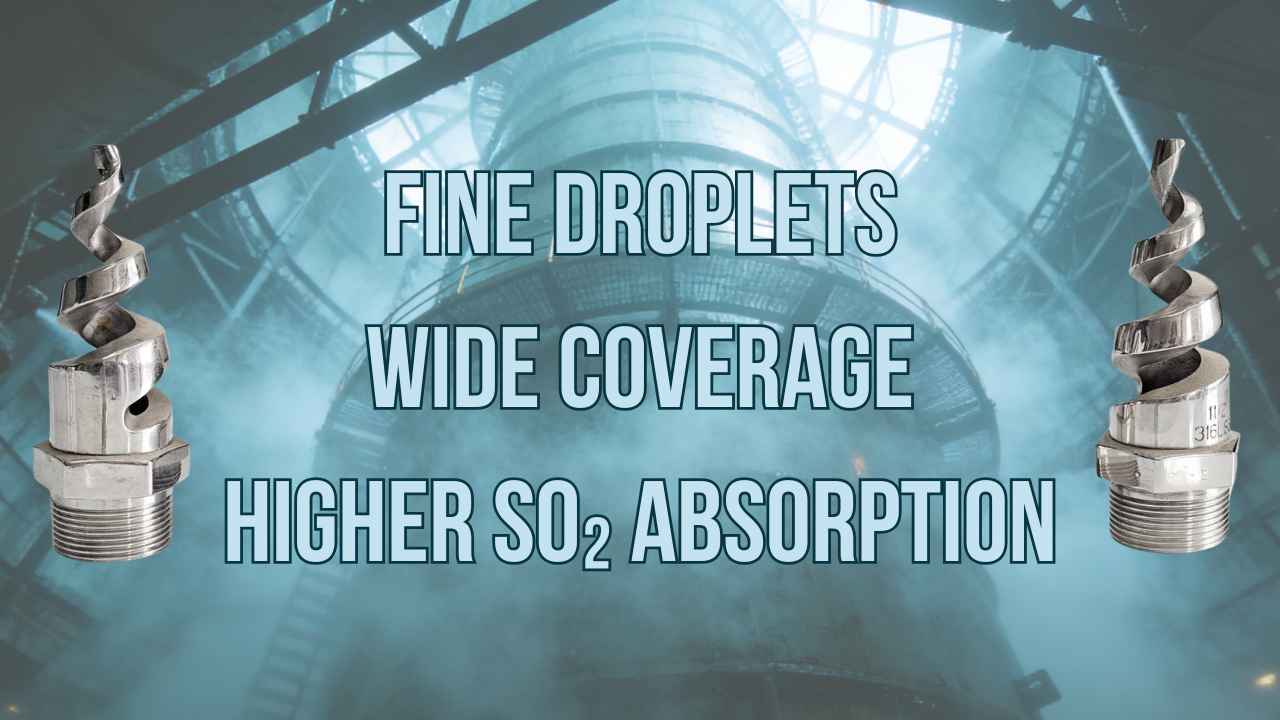
Wet Flue Gas Desulfurization (FGD) systems depend on high-performance spray nozzles to remove sulfur dioxide (SO₂) from industrial flue gas. Spray nozzles atomize absorbent liquids—such as limestone slurry, lime water, or seawater—into fine droplets. These droplets increase the gas-liquid contact area, accelerate SO₂ mass transfer, and improve the overall efficiency of the absorber tower.
The Role of Spray Nozzles in Wet FGD Performance
Spray nozzles directly influence droplet size, spray coverage, and contact efficiency. Proper nozzle selection and spray layer arrangement help eliminate dead zones, stabilize mass transfer, and reduce absorbent waste. To achieve optimal SO₂ removal, nozzle performance must align with key process parameters such as L/G ratio, pH, slurry density, and absorber temperature.
Types of FGD Spray Nozzles
Spiral nozzles create a wide spray angle and allow a large free passage for slurry flow. Their streamlined internal geometry helps reduce clogging when handling liquids with suspended solids. These nozzles perform well in pre-wash sections, quenching zones, and circulating slurry systems where blockage risk is higher. Material choice—such as ceramic or SiC—further enhances wear resistance in abrasive conditions.
Full cone nozzles generate a dense, uniform spray pattern with consistently controlled droplet size. Their stable atomization makes them suitable for primary absorption layers, where uniform gas-liquid contact is essential. Full cone nozzles help maintain coverage even under variable flow rates, but overall absorbent consumption still depends on spray layer design, droplet size distribution, and process tuning rather than nozzle type alone.
Key Functions of FGD Spray Nozzles
FGD spray nozzles support several essential functions within the tower:
- Atomization: Produce fine droplets with controlled Sauter Mean Diameter (SMD) to increase mass transfer efficiency.
- Uniform Coverage: Deliver an even spray pattern to minimize dead zones and enhance SO₂ absorption.
- Process Stability: Maintain consistent performance under varying flow rates and slurry conditions.
- Operational Efficiency: Reduce slurry waste and prevent unreacted droplets from leaving the absorber.
- Cooling and Pre-Treatment: Provide quenching or humidification at the absorber inlet when required.
Industrial Applications of FGD Spray Nozzles
FGD spray nozzles are used across various industries that require effective control of SO₂ and acidic gases:
- Coal-Fired Power Plants: Main absorber towers for SO₂ removal.
- Steel and Metallurgical Plants: Sintering and BOF/EOF scrubbers for sulfur and particulate reduction.
- Cement Plants: Kiln tail gas treatment with combined desulfurization and dust control.
- Waste-to-Energy Plants: Removal of acidic gases and mitigation of dioxin formation.
- Chemical and Petrochemical Plants: Tail gas scrubbing of SO₂, HCl, HF, and other acidic components.
- Pulp & Paper, Food Processing, Biomass Boilers: Flue gas cleaning and odor control for emission compliance.
Recommended Materials for FGD Spray Nozzles
Material selection depends on both corrosion level and slurry abrasiveness:
- 316L Stainless Steel: Suitable for low-chloride, moderate-corrosion environments.
- Duplex Stainless Steel: Better resistance to chloride-induced pitting and erosion-corrosion.
- Ceramic / Silicon Carbide (SiC): Excellent wear resistance for high-solids or abrasive slurries.
- PVDF / PTFE: High corrosion resistance in low-abrasion environments, not recommended for heavy-slurry service.
Selecting the correct material requires evaluating chloride concentration, particle size, pH, and system operating temperature.
FAQ — FGD Spray Nozzles
Q1: How often should FGD spray nozzles be maintained?
Maintenance frequency depends on slurry solids, particle size, nozzle material, and operating pressure. Nozzles with large free passages or ceramic/SiC construction typically resist wear and clogging for longer periods. Regular inspections should monitor flow rate changes, pressure drop, and spray pattern quality.
Q2: How can SO₂ removal efficiency be improved?
Efficiency improves when spray nozzles deliver controlled droplet size and uniform coverage. Optimizing spray layer arrangement, L/G ratio, absorbent concentration, and tower temperature also enhances mass transfer. Nozzle selection works best when combined with overall process optimization.
Q3: What factors determine the best nozzle material for FGD use?
Material selection depends on corrosion level, chloride content, slurry abrasiveness, and desired service life. Duplex stainless steel and ceramic materials are preferred in high-wear or high-chloride conditions.
Spray nozzles are critical components in wet FGD systems. Spiral nozzles provide wide coverage and clog-resistant flow paths, while full cone nozzles deliver stable, uniform atomization for high-efficiency absorption. When combined with proper process control and material selection, these nozzles help power plants, steel mills, cement facilities, and waste-to-energy plants achieve reliable SO₂ reduction and environmental compliance.
Looking for reliable spray nozzles for your FGD system?
Contact our engineering team today for technical consultation, nozzle selection support, and customized solutions for your plant.