
 Medical Modular Storage
 English
 Español
 Portugues
 Français
 Deutsch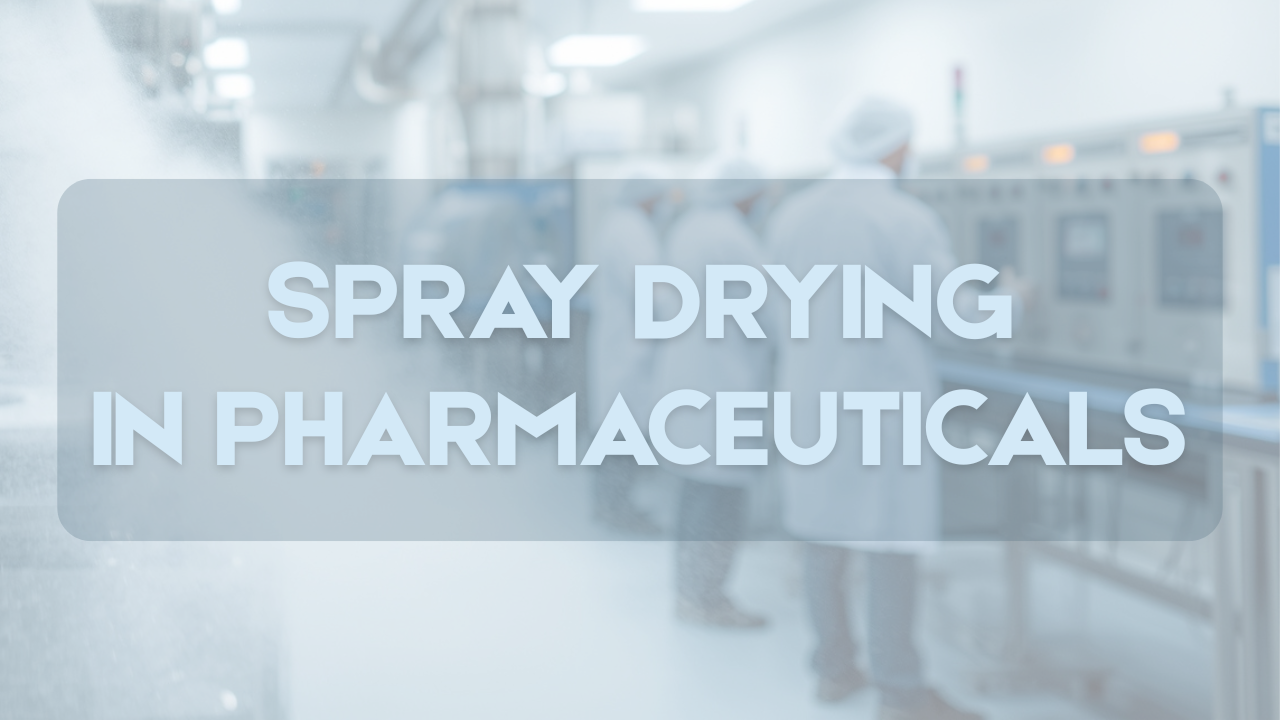
Spray drying is a cornerstone technology in pharmaceutical manufacturing. It transforms liquid formulations—solutions, emulsions, or suspensions—into uniform powders through rapid atomization and controlled hot air drying. This produces powders suitable for tablets, capsules, inhalable drugs, and amorphous solid dispersions (ASDs) while maintaining particle uniformity, stability, and bioavailability.
Spray drying offers several advantages. It allows precise particle control for consistent drug performance, enhances solubility of poorly soluble APIs via amorphous solid dispersions, and provides gentle drying for heat-sensitive biologics, proteins, and vaccines. Additionally, it supports scalable, continuous production in compliance with GMP regulations and integration with PAT systems.
Spray Drying Nozzles
Nozzles are the heart of any spray drying system. They control droplet size, atomization quality, and powder characteristics, directly affecting product stability and process efficiency.
|
Nozzle Type |
How It Works |
Typical Applications |
|
Two-Fluid Nozzle (Pneumatic Atomizer) |
Uses compressed gas to gently atomize liquid |
Lab and pilot-scale drying, proteins, vaccines |
|
Pressure Nozzle (Hydraulic Atomizer) |
High-pressure atomization; uniform droplets, high throughput |
Large-scale continuous production, amorphous solid dispersions |
|
Rotary Atomizer |
High-speed rotating disk creates fine droplets; narrow size distribution |
Industrial-scale production, stable powders |
|
Ultrasonic Nozzle |
Ultrasonic vibration generates fine, low-shear droplets |
R&D drying, inhalable drugs, nano-formulations |
Recent Innovations
Modern spray drying systems focus on precision, smarter control, and eco-friendly operation:
- Ultrasonic & micro-spray atomization – Narrow droplet distributions for inhalable and nano-scale drugs.
- Digital modeling & AI optimization – Enhance reproducibility and energy efficiency.
- Low-temperature & spray freeze-drying (SFD) – Preserve sensitive biologics.
- Water-based, eco-friendly systems – Reduce solvent usage and carbon footprint.
- Next-generation nozzles – Anti-clogging, corrosion-resistant, CIP/SIP compatible for continuous GMP operations.
Pilot trials show ultrasonic nozzle upgrades can reduce clogging by up to 40%, improving uptime and yield.
FAQ: Pharmaceutical Spray Drying
Spray drying combines precision, scalability, and flexibility, making it central to modern pharmaceutical manufacturing. Innovations in nozzle design, AI integration, and eco-friendly processes are transforming spray drying into a comprehensive particle engineering platform. Proper nozzle selection, combined with advanced process monitoring, ensures consistent, high-quality, and sustainable drug production.
Need Help Choosing a Nozzle?
Let our experts help you find the right spray drying nozzle for your process.
Contact us for tailored solutions.